
📜 Defamation & Section 65B of the Indian Evidence Act: A Practical Walkthrough

In today’s digital world, reputations can be damaged in seconds through social media posts, WhatsApp forwards, emails, blogs, or online reviews. When such content becomes the subject of a defamation case, courts rely heavily on electronic evidence. This is where Section 65B of the Indian Evidence Act becomes crucial.
This guide explains how Section 65B works in defamation cases, why it is important, and how electronic records can be legally proven in court.
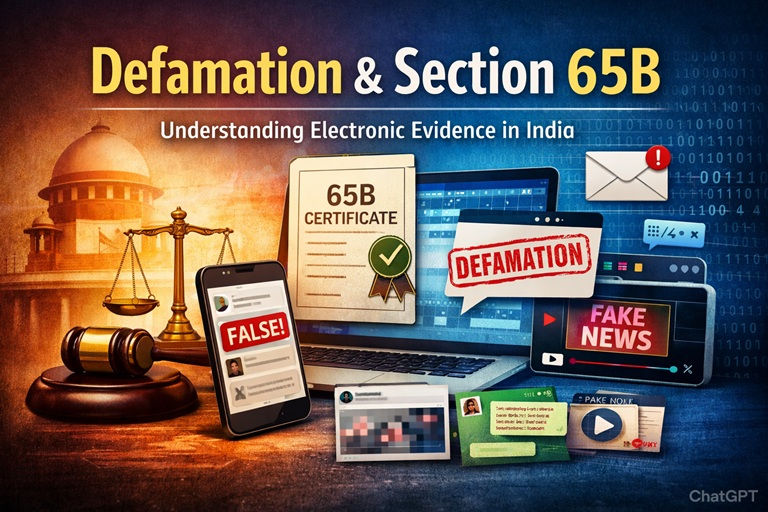
⚖️ Understanding Defamation in India
Defamation occurs when a false statement is made or published that harms a person’s reputation.
Types of Defamation
Libel – Written or published defamatory content (articles, social media posts, blogs).
Slander – Spoken defamatory statements.
Legal Remedies
Civil Defamation – Compensation for reputational harm.
Criminal Defamation – Punishable under Sections 499 & 500 of the Indian Penal Code.
💻 What is Section 65B?
Section 65B governs the admissibility of electronic records as evidence in Indian courts.
Electronic Records Include:
✔ Emails✔ WhatsApp chats✔ Social media posts✔ Digital photos & videos✔ Website content✔ Audio recordings✔ Call recordings
Without compliance with Section 65B, such digital evidence may be rejected by the court.
🧾 Why Section 65B Matters in Defamation Cases
Most defamatory content today exists in digital form. Courts require proof that the electronic content:
✔ is authentic✔ has not been tampered with✔ was produced from a reliable device
A Section 65B Certificate validates the authenticity of electronic evidence.
📑 What is a Section 65B Certificate?
It is a written certification accompanying electronic evidence confirming:
the device used to create the record
the manner in which it was produced
integrity and accuracy of the data
details of the person issuing the certificate
Who Can Issue It?
A person responsible for the device/system used to produce the electronic record (e.g., system admin, device owner).
🧑⚖️ Landmark Judicial Clarification
The Arjun Panditrao Khotkar v. Kailash Kushanrao Gorantyal judgment clarified that:
✔ Section 65B certificate is mandatory for electronic evidence.✔ Oral proof alone is insufficient.✔ Courts require compliance unless the original device is produced.
🔎 How Section 65B Works in Defamation Cases
Step-by-Step Process
Capture the defamatory content (screenshot, download, or backup).
Preserve the original electronic source.
Obtain a Section 65B certificate.
Submit both evidence and certificate to the court.
📌 Practical Examples
Example 1: Social Media Defamation
A person posts false allegations on Facebook harming a business reputation.
Evidence Required:
Screenshot of post
URL & timestamp
Section 65B certificate
Example 2: WhatsApp Message Defamation
A defamatory message is circulated in a housing society WhatsApp group.
Evidence Required:
Chat export file
Phone details
Section 65B certificate
Example 3: YouTube Video Allegations
A video falsely accuses someone of fraud.
Evidence Required:
Video download
Link & metadata
Section 65B certificate
⚠️ Common Mistakes That Lead to Rejection of Evidence
❌ Submitting screenshots without certification❌ Editing or cropping digital evidence❌ Failing to preserve original data❌ Not identifying the device source
🛡️ Tips to Protect Yourself
✔ Preserve digital content immediately✔ Avoid altering evidence✔ Maintain backups✔ Consult a legal professional early✔ Ensure proper certification
❓ FAQ: Section 65B & Defamation
1. Is a screenshot enough proof in court?
No. A Section 65B certificate is generally required to validate electronic evidence.
2. Can WhatsApp chats be used as evidence?
Yes, if accompanied by a valid Section 65B certificate.
3. Who issues the certificate?
The person responsible for the device or system producing the electronic record.
4. What if the original device is available?
Courts may accept the original device, but certification is usually still preferred.
5. Is the certificate required in all digital cases?
As per Supreme Court rulings, it is generally mandatory for admissibility.
📝 Conclusion
In defamation cases, especially those involving online content, Section 65B plays a decisive role in proving authenticity. Without proper certification, even strong digital proof may become legally unusable. Understanding this provision ensures that victims of digital defamation can effectively protect their reputation through lawful remedies. Connect with Experts:
📞 9611195911 | 🌐 mysla.in
⚖️ Disclaimer
This article is intended for general informational and educational purposes only. It does not constitute legal advice or create a lawyer-client relationship. Laws and judicial interpretations may change, and application varies based on specific facts and jurisdiction. Readers should consult a qualified legal professional before taking any legal action.


Comments