
E-Khata vs Physical Khata in Karnataka – Complete 2026 Guide

Understanding the Difference, BBMP Migration Process, Common Mistakes, and Impact on Property Sale & Home Loans By Sairam Law Associates
Introduction
Property ownership in Karnataka has undergone significant digital transformation over the past few years. One of the most frequently asked questions by property owners, buyers, and investors today is:
"Is my property having a Physical Khata or E-Khata, and does it matter?"
The answer is Yes. It matters significantly, especially when buying, selling, obtaining a home loan, applying for building plan approvals, or dealing with municipal authorities.
Many property owners possess a traditional paper Khata certificate and assume everything is in order. However, with the increasing digitization of municipal records, verifying whether the property is reflected in the official electronic database has become equally important.
This guide explains everything you need to know about Khata, E-Khata, migration procedures, legal implications, common mistakes, and practical examples.
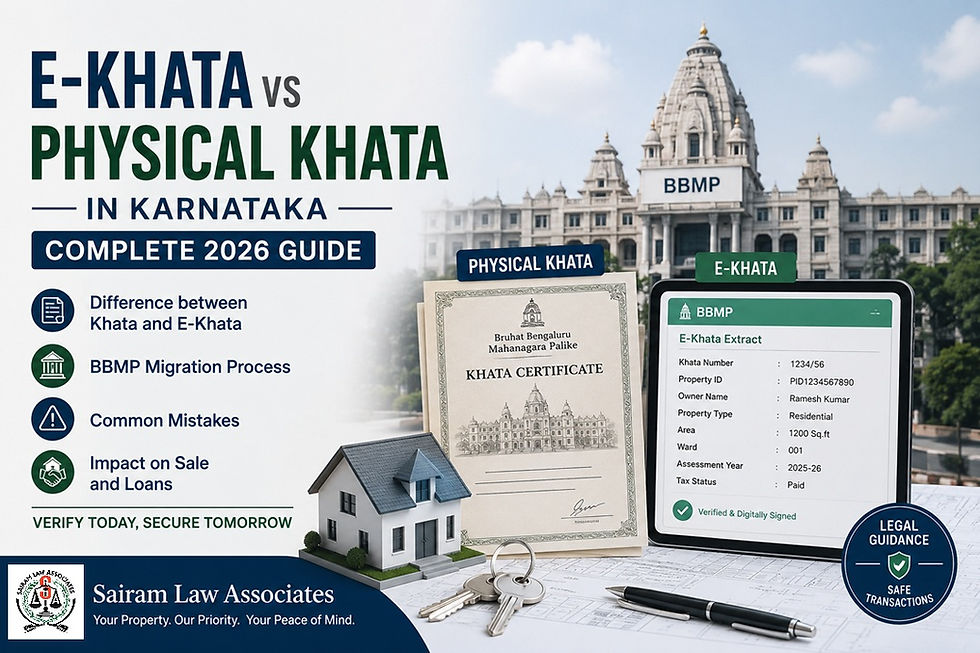
What is a Khata?
A Khata is a municipal revenue record maintained by the local authority showing:
Property ownership details
Property identification number
Property dimensions
Tax assessment details
Property tax payment records
Simply put:
Khata is an entry in municipal records recognizing a property for taxation purposes.
A Khata generally consists of:
1. Khata Certificate
Evidence that the property is registered in municipal records.
2. Khata Extract
Detailed property information maintained by the municipality.
What is an E-Khata?
E-Khata (Electronic Khata) is the digital version of property records maintained in the municipal online database.
The information available in the physical records is digitized and linked with municipal databases, enabling:
Online verification
Digital record maintenance
Easier ownership tracking
Better tax administration
Reduced record manipulation
E-Khata vs Physical Khata – Key Differences
Particulars | Physical Khata | E-Khata |
Record Format | Paper-based | Digital Record |
Verification | Manual | Online Verification |
Risk of Record Loss | Higher | Lower |
Accessibility | Municipal Office Visit | Online Access |
Ownership Updates | Slower | Faster |
Property Tax Integration | Partial | Fully Integrated |
Loan Processing | May require additional verification | Preferred by banks |
Future Municipal Services | Limited | Easier Access |
Important Note
Having a Physical Khata does not automatically guarantee that the property has been properly migrated into the E-Khata system.
Both records should ideally match.
Why E-Khata Became Important in Karnataka
The Government and municipal authorities have increasingly shifted towards digital governance to:
Reduce fraud
Improve transparency
Create centralized property records
Facilitate online tax collection
Simplify property transactions
As a result, many buyers and banks now verify whether the property appears in municipal electronic records before proceeding.
Practical Example 1 – Property Sale
Situation
Mr. Ramesh purchased a site in 2012.
He possesses:
✅ Registered Sale Deed
✅ Physical Khata Certificate
✅ Tax Paid Receipts
However, during sale in 2026, the buyer's advocate discovers that the property is not reflected properly in municipal digital records.
Consequence
The buyer seeks:
Clarification
Record correction
E-Khata verification
This creates delay in registration and negotiation.
Lesson
Physical documents alone may not be sufficient.
Digital municipal records should also be verified.
Practical Example 2 – Home Loan Application
Situation
Mrs. Lakshmi applies for a housing loan.
The bank verifies:
Title documents
Encumbrance Certificate
Khata records
Tax records
The property has a Physical Khata but municipal records require migration and updating.
Result
Loan processing may be delayed until municipal records are clarified.
Lesson
Properly updated municipal records often facilitate smoother due diligence.
BBMP E-Khata Migration Process – Step-by-Step Guide
The exact procedure may vary depending on municipal notifications and system updates.
Generally, the process involves:
Step 1 – Document Collection
Keep ready:
Sale Deed
Latest Tax Paid Receipts
Previous Khata Documents
Aadhaar/PAN
Property Details
Encumbrance Certificate (where required)
Step 2 – Verify Existing Municipal Records
Check:
Property Identification Number
Owner Name
Property Dimensions
Tax Assessment Details
Step 3 – Submit Application
Application can generally be submitted through designated BBMP portals or municipal procedures prevailing at the relevant time.
Step 4 – Scrutiny by Authorities
Municipal officials may verify:
Ownership records
Property tax status
Property measurements
Existing Khata details
Step 5 – Record Migration / Update
Upon successful verification:
Property records are updated
Digital entries are generated
E-Khata becomes available
Common Mistakes Made by Property Owners
Mistake 1 – Assuming Physical Khata is Enough
Many owners never verify digital records.
Years later, issues arise during sale or loan processing.
Mistake 2 – Not Updating Ownership After Purchase
After purchasing property, some buyers fail to update municipal ownership records promptly.
Example
Sale Deed shows:
Owner: Mr. Kumar
Khata still shows:
Owner: Mr. Rajesh
This discrepancy can create avoidable complications.
Mistake 3 – Ignoring Property Tax Mismatches
Even minor errors in:
Site number
Area
Owner name
can create future difficulties.
Mistake 4 – Delaying Rectification
Many owners discover discrepancies but postpone corrections until:
Sale
Loan
Development approval
By then timelines become critical.
Mistake 5 – Not Conducting Legal Due Diligence
Purchasers often verify only:
✔ Sale Deed
But ignore:
✔ Khata Records
✔ E-Khata Status
✔ Tax Records
✔ Encumbrance Records
Documents Buyers Should Verify Before Purchase
Before purchasing any property, verify:
Title Documents
Parent Documents
Sale Deed
Gift Deed (if applicable)
Municipal Records
Khata Certificate
Khata Extract
E-Khata Status
Revenue Records
Tax Paid Receipts
Registration Records
Encumbrance Certificate
Layout Approvals
Applicable Approvals
Sanctions
Conversion Documents (if applicable)
Impact on Property Sale
A properly maintained E-Khata may help:
Faster due diligence
Better buyer confidence
Easier municipal verification
Smoother documentation process
Where discrepancies exist:
Sale negotiations may be delayed
Additional clarifications may be required
Legal review becomes more extensive
Impact on Home Loans
Most banks conduct document verification before sanctioning loans.
They generally review:
Ownership records
Municipal records
Tax records
Encumbrance records
Where municipal records contain inconsistencies:
Additional documents may be requested
Clarifications may be sought
Processing timelines may increase
Frequently Asked Questions (FAQs)
Is E-Khata a title document?
No.
E-Khata is a municipal record for taxation and property administration purposes.
Ownership is primarily established through valid title documents such as registered sale deeds.
Can a property be sold without E-Khata?
Sale legality depends on several factors including title, approvals, and applicable laws.
However, absence of proper municipal record updates may create practical challenges during due diligence.
Is Khata proof of ownership?
Khata alone is not conclusive proof of ownership.
It is primarily a municipal taxation record.
Ownership should always be supported by valid title documents.
Should buyers verify E-Khata before purchase?
Yes.
Municipal record verification should form part of comprehensive legal due diligence.
Can errors in E-Khata be corrected?
In many cases, yes, subject to verification and applicable municipal procedures.
How Sairam Law Associates Can Assist
Our property law team assists clients with:
✔ Property Legal Due Diligence
✔ Khata Verification
✔ E-Khata Review
✔ Property Documentation
✔ Sale Deed Verification
✔ Title Investigation
✔ Municipal Record Compliance
✔ Real Estate Legal Advisory
Whether you are purchasing a residential site, apartment, villa, commercial property, or investment land, obtaining proper legal verification before proceeding can significantly reduce future risks.
Conclusion
The shift from traditional municipal records to digital property administration has made E-Khata verification an important aspect of property transactions in Karnataka.
While Physical Khata continues to remain relevant, ensuring that the property is correctly reflected in municipal electronic records can help avoid delays, disputes, and documentation issues during sales, loans, and future property transactions.
Before purchasing or selling any property, conduct a complete review of:
Title Documents
Khata Records
E-Khata Status
Tax Records
Encumbrance Records
A timely legal review can often prevent costly complications later.
Disclaimer
This article is published by Sairam Law Associates for general informational and educational purposes only and does not constitute legal advice, legal opinion, or solicitation. Property laws, municipal regulations, BBMP procedures, E-Khata requirements, and government notifications may change from time to time. Readers are advised to obtain independent legal advice and verify the latest applicable rules, procedures, and documentation requirements before taking any decision relating to property purchase, sale, loan processing, Khata transfer, E-Khata migration, or municipal compliance. Sairam Law Associates shall not be responsible for any action taken based solely on the contents of this article.


Comments