
30 Legal Documents Every Property Buyer Must Verify Before Registration in Karnataka (2026 Complete Guide)

Introduction
Buying a property is one of the biggest financial decisions in a person's life. Unfortunately, many buyers focus only on the location, price, and amenities while ignoring the legal verification process. A property that looks perfect today can become a legal nightmare tomorrow if the ownership records, approvals, or title documents are not properly verified.
At Sairam Law Associates, we regularly assist buyers in conducting legal due diligence before property registration. This guide explains the 30 most important documents every property buyer should verify before making payment or registering a property in Karnataka.

Why Property Legal Documents Verification is Important
Proper legal verification helps buyers:
✅ Confirm clear ownership
✅ Avoid fraudulent transactions
✅ Verify government approvals
✅ Prevent future litigation
✅ Ensure loan eligibility
✅ Secure long-term investment value
Ownership & Title Documents
1. Sale Deed
The Sale Deed is the primary ownership document that transfers property ownership from seller to buyer.
Example:
If Mr. A purchased a site from Mr. B in 2018, the registered Sale Deed proves the transfer.
Verify:
Seller name
Property measurements
Registration details
Schedule of property
2. Mother Deed
The Mother Deed traces the ownership history of the property.
Example:
Property ownership chain from 1985 → 1995 → 2010 → Present Owner.
Verify:
Continuous ownership records
No missing transactions
Proper transfer chain
3. Gift Deed (if applicable)
Required when property is received through family transfer.
4. Partition Deed
Important for ancestral or jointly owned properties.
5. Release Deed
Shows relinquishment of rights by legal heirs or co-owners.
6. Family Tree Certificate
Required where ownership is inherited.
7. Legal Heir Certificate
Verifies lawful successors after the owner's death.
Revenue Records
8. RTC (Record of Rights, Tenancy and Crops)
Shows ownership and land details for agricultural properties.
Verify:
Owner's name
Survey number
Land extent
9. Mutation Extract
Confirms ownership transfer in revenue records.
10. MR (Mutation Register)
Supporting record for ownership changes.
11. Tippani
Survey sketch showing property boundaries.
12. Survey Sketch
Official survey map issued by the revenue department.
13. Phodi Records
Required if land has been subdivided.
Encumbrance & Registration Records
14. Encumbrance Certificate (EC)
One of the most important documents.
Verify:
Mortgages
Court attachments
Previous sales
Charges on property
Example:
If the property is pledged to a bank, it will generally appear in the EC.
15. Index of Lands
Provides registration history.
16. Certified Copies of Previous Deeds
Cross-check ownership records.
Municipal Documents
17. Khata Certificate
Confirms municipal recognition of the property.
18. Khata Extract
Contains property assessment details.
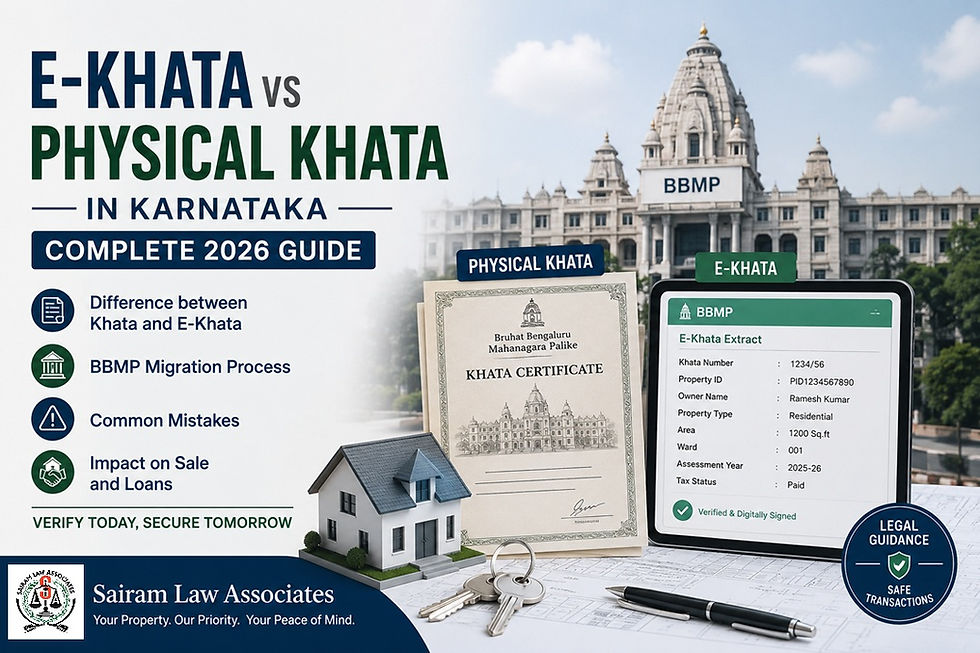
19. E-Khata
Mandatory for many transactions under BBMP jurisdiction.
20. Property Tax Receipts
Verify that taxes are paid up-to-date.
Example:
Request receipts for the last three years.
Layout & Building Approval Documents
21. Approved Layout Plan
Verify approval by competent authorities.
22. Approved Building Plan
Ensure construction matches approved drawings.
23. Building License
Permission issued before construction.
24. Commencement Certificate (CC)
Allows legal commencement of construction.
25. Occupancy Certificate (OC)
Issued after construction completion and compliance verification.
Why Important?
Without OC:
Utility connections may face issues
Future resale may become difficult
Loan approval may be affected
26. Completion Certificate
Confirms project completion according to approved plans.
Apartment-Specific Documents
27. RERA Registration Certificate
Mandatory for applicable projects.
Verify:
Project registration number
Promoter details
Completion timeline
28. Allotment Letter
Issued by builder upon booking.
29. Construction Agreement
Defines construction obligations and specifications.
30. Sale Agreement
Sets out terms and conditions before final registration.
Additional Documents Buyers Should Verify
Apart from the above 30 documents, buyers should also verify:
Bank NOC (if property was financed)
Court litigation search
BESCOM connection records
BWSSB connection records
Aadhaar and PAN of seller
Possession Certificate
No Due Certificate from Builder
Apartment Association NOC
Red Flags Every Buyer Must Watch
🚩 Seller unable to produce original documents
🚩 Missing ownership records
🚩 Pending court disputes
🚩 Unapproved layouts
🚩 Tax arrears
🚩 Mortgage not released
🚩 Deviations from approved plans
🚩 Multiple ownership claims
How Sairam Law Associates Can Help
Our property verification services include:
✔ Complete title verification
✔ Document scrutiny
✔ EC verification
✔ Khata and mutation verification
✔ Layout and plan approval verification
✔ RERA verification
✔ Registration support
✔ Legal opinion and due diligence reports
Before investing lakhs or crores in any property, obtaining a professional legal opinion can save years of litigation and financial loss.
Conclusion
A property purchase should never be based solely on trust or verbal assurances. Every buyer must carefully verify ownership documents, revenue records, municipal approvals, encumbrance records, and construction approvals before registration.
A thorough legal verification process ensures that your investment remains safe, marketable, and free from future disputes. Whether you are purchasing a site, villa, apartment, or commercial property, verifying these 30 essential documents can help you make an informed and legally secure decision. Disclaimer: The information provided in this article is for general informational and educational purposes only and should not be considered legal advice, legal opinion, or a substitute for professional consultation. Property laws, registration procedures, revenue records, and regulatory requirements may vary based on the nature and location of the property and are subject to change. While every effort has been made to ensure the accuracy of the content, Sairam Law Associates makes no representations or warranties regarding its completeness or current applicability. Readers are advised to seek independent legal advice and conduct proper due diligence before making any property-related decisions, investments, or transactions. Accessing or reading this article does not create an advocate-client relationship with Sairam Law Associates.


Comments